UNITED KINGDOM NATIONAL SECULAR SOCIETY ARTICLE: Abuse Inquiry to Investigate Benedictine Institutions. Comments by Brian Mark Hennessy

UNITED KINGDOM NATIONAL SECULAR SOCIETY ARTICLE
Abuse Inquiry to Investigate Benedictine Institutions

Comments by Brian Mark Hennessy

An upcoming hearing of the Independent Inquiry into Child Sexual Abuse will be an opportunity to examine the reality behind the Catholic Church’s claims that it has transformed its approach to child protection, says Richard Scorer.
_____________________________________________________________________________________
At the end of November, the Independent Inquiry into Child Sexual Abuse (IICSA) will begin hearings into the English Benedictine Congregation (EBC), a Catholic monastic order. The focus of the hearings will be abuse scandals at two elite private schools associated with the order, Ampleforth and Downside. A future hearing will examine events involving St Benedict’s school and the associated abbey in Ealing, West London.

What might we expect the inquiry to look at? A repeated refrain from the Catholic Church is that whilst there were dreadful safeguarding failures in the past, the Church has now transformed its approach to child protection. As a lawyer representing survivors of abuse in Catholic institutions, I recognise that some progress has been made in safeguarding. But I question whether that progress has been anything like fast enough, and whether new procedures have been underpinned by a conversion of “hearts and minds”. In 2001, the late Cormac Murphy-O’Connor, Catholic Archbishop of Westminster promised that with the ‘Nolan’ reforms the Catholic Church would become a “beacon for child protection”. Fundamental to this was the Church eschewing its past practice of dealing with cases ‘in-house’, and ensuring that all allegations of clerical sex abuse would henceforth be reported to police or social services ¬– something which it surprises many people to discover is still not a formal legal requirement.
The new policy was supposed to mean not only reporting of future allegations, but also that the Church would “cleanse the stables” by identifying past concerns and ensuring that those too would now be reported, especially where the cleric or teacher concerned continued to have contact with children. That at least was the promise: the hearings will provide an opportunity to examine the reality. The issue of reporting comes into sharp focus with Benedictine institutions: many of the scandals in the Benedictine Congregation are recent, and cannot simply be dismissed as ancient history from decades ago; moreover, the Benedictine culture seems to have been particularly resistant to external reporting.

Downside is a case in point. The Nolan reforms were announced in 2001. Yet in 2012, an abuse victim and former pupil from Downside alleged that the school was “infiltrated by paedophiles at all levels”. Anyone inclined to dismiss this as hyperbole should consider the facts. The victim’s comments followed the conviction that year of Father Nicholas White, a Downside monk who also taught at the school. White was jailed in 2012 for gross indecency and indecent assault on a pupil in the late 1980s. But the school had known about White’s behaviour since 1987. Documents made available at White’s trial indicated that the school had sought legal advice in the late 1980s as to whether they were legally obliged to report the allegations to the authorities; the absence of a mandatory reporting law meant that they were not obliged to do so, although one might think that a responsible institution concerned for the welfare of children would have elected to do so anyway. So no report was made. White had been allowed to continue teaching after he was first caught abusing a child in 1987, merely being restricted to teaching the very youngest boys; he then went on to assault another pupil in the school.

After the second incident, White was sent away to Fort Augustus, a Benedictine outpost in Scotland (This practice of moving a known or suspected sex abuser from one institution to another, failing to alert the recipient institution and failing to alert the authorities – a practice known colloquially as “move and forget” – appears to have been common in the Benedictine
Congregation, with some suspected abusers being sent as far away as Australia; victims’ lawyers have urged the inquiry to examine it closely in the upcoming hearings).
In 1998 White eventually returned to Downside. Despite the promises of openness which followed the Nolan reforms in 2001, police were not informed of the earlier allegations, and White was not arrested, until 2010. The police only stumbled across the case by accident during a separate investigation into another clerical sex offender at the school (an investigation initiated by another client of mine, who will be giving evidence in the upcoming hearings). The eventual exposure of White’s activities led to a flurry of inspections by Ofsted and the Independent Schools Inspectorate (ISI). The inspection reports make unhappy reading: the ISI complained of “serious mismanagement” of safeguarding and observed that in this respect, the school was “effectively in special measures”.
The school’s longstanding practice of inviting pupils from the school into the monastery for “overnight retreats” was only stopped in 2011 at the ISI’s insistence, since the monastery contained monks who were on “restricted ministry” because of the risk they posed to children. All of this begs the question, of course, of why those shortcomings hadn’t been picked up by inspectors previously: things had clearly been amiss for years, but it was only White’s arrest that brought these issues to light. Again this will be an important issue for the inquiry. The organisations responsible for inspection will almost certainly argue that they are not a police force. In the absence, therefore, of a mandatory legal duty on institutions to proactively report knowledge or suspicion of abuse, there is a high risk that much of it will go undetected by external agencies. I agree, but the concern must also be that the elite status of these schools and their apparently spiritual ethos blinded inspectors to the underlying reality.

Similar concerns have arisen at Ampleforth, the other institution to be examined in the upcoming hearings. Scandals there have a long vintage, dating back to the days when Cardinal Basil Hume was headmaster. In those days the practice of “move and forget” seems to have involved removing clerical sex offenders from the school and dumping them in Ampleforth’s “mission parishes”, working class districts where monks would be sent from Ampleforth for outreach work amongst the poor.

One of my clients who grew up in Workington on the Cumbrian coast was abused there as a young boy by Father Gregory Carroll, who had been rusticated to a “mission parish” in Cumbria following abuse of pupils at Ampleforth. The local community in Cumbria were told nothing about Carroll’s history. That was in the late 1980s.

But the issues at Ampleforth are far from historic: some of the recent scandals have been painstakingly detailed by Andrew Norfolk of The Times. A teacher was convicted and jailed earlier this year for sexual exploitation of a pupil in the very recent past; this went on for several years. Safeguarding procedures at Ampleforth had ostensibly been updated but the more recent cases suggest some attitudes and culture remain ossified.

Jonathan West, a leading campaigner for mandatory reporting who also helped to expose the scandals at St Benedict’s, makes the remarkable point that despite the English Catholic Church’s apparent conversion to the idea of external reporting after 2001, not a single case of abuse in the English Catholic Church has subsequently come to light because a Catholic institution decided to formally report it; cases continue to come to light only because of the bravery of victims or whistleblowers.
Against that backdrop, the leadership of the English Benedictine Congregation will also rightly be under scrutiny. For 8 of the 12 years between 1998, when Father Nicholas White returned to Downside, and 2010, when he was arrested, White’s Abbot at Downside was Richard Yeo. Yeo was certainly aware of White’s history; he was also in charge at Downside when White was permitted to return. But Yeo had another important role as well: between 2001 and 2017 he was President of the entire English Benedictine Congregation. In the light of the sorry history described above, it is perhaps no surprise that earlier this year Yeo stood down as Abbot President of the Congregation, to be replaced by the apparently more media savvy Christopher Jamieson, a former Abbot of Worth Abbey.

However, Yeo has been called to give evidence in the upcoming hearings. On his watch, several of the EBC institutions have failed to implement the separation in governance between the school and the monastery recommended by the Carlile Report into the scandals at St Benedict’s Ealing; the governance reform was implemented there, but not at Ampleforth and Downside. This is one of many decisions he will need to defend. (Remarkably, Yeo, in addition to the other positions he held, was also a member of the 2007 Cumberlege commission, whose task was to review the way the Catholic Church in England and Wales responded to Nolan. He is therefore considered by the Catholic church to be one of their leading authorities on child protection).

Of course, there have been many abuse scandals in secular institutions: nobody would claim that religious institutions are uniquely affected. However, the Benedictine scandals highlight some of the ways in which religious culture can increase the risk of abuse, and the risk of it being swept under the carpet. In Benedictine institutions, the geographical reach of the Congregation led to the dumping of paedophile monks in missions or abroad. Monasticism meant monks having freedom and no oversight. The adamantine certainty of belief and sense of spiritual rectitude which sometimes characterise religious organisations make it harder to ensure the institutional challenge, self-awareness and self-criticism which are so necessary to uncovering and tackling abuse. All of this makes a powerful case for mandatory reporting, a change supported by the NSS and hopefully in due course by IICSA itself.
_____________________________________________________________________________
COMMENTS BY BRIAN MARK HENNESSY,
A MEMBER OF THE COMBONI SURVIVORS GROUP.

The Benedictine Order is not the only Catholic Order that will be coming under the spotlight of the United Kingdom Independent Inquiry into Child Sexual Abuse. The Italian Comboni Missionary Order, which has operated within the United Kingdom in varying numbers since the end of the First World War, will also be the subject of a specially convened hearing to establish the diverse ways in which Orders of the Catholic Church have boldly striven to conceal abuse and hide its perpetrators. Unsurprisingly, many of the failures exposed above in the Benedictine Order were also common practices within the Italian Comboni Missionary Order.

Once known more commonly as the Verona Fathers, the Comboni Missionaries have had communities in Dawson Place London, Sunningdale in Berkshire, Leeds, Glasgow and Dublin almost continuously since the end of the Second World War. Perhaps their best known establishment, however, was at Mirfield in Yorkshire where they had a seminary for teenage boy aspirants to the priesthood from 1960 to the early 1980’s. Although it was not the only location of a Comboni Order seminary in the United Kingdom over the years where abuse is known to have taken place, Mirfield has become the most notorious on account of allegations of some 1000 incidents of child sexual abuse perpetrated there by clerics of the Order and a lay teacher. There have been additional allegations made against two more priests at Mirfield who have not been publicly named. Yet another priest is the subject of current legal proceedings.

The Comboni Missionary Order has resisted attempts by the West Yorkshire Police to have one of the priests still alive today extradited to the United Kingdom to face criminal charges. That priest named, Romano Nardo, a native of Prata di Sopra in Pordenone, Italy, was located in Uganda at the Aduku Mission in the Diocese of Lira from the time that his abuse of a thirteen year old boy was discovered at Mirfield. In that Uganda Mission he had access to children for decades – and there also he founded a school which is named after him. Following his exposure as a priest who had abused boys at the Mirfield seminary, he was moved from Uganda to Verona in Italy. After his discovery there in 2015 by one of his former victims, he was again moved to a secret place of hiding where he remains today under constant guard in order to prevent his extradition to the United Kingdom.

According to a press release in the publication “Il Gazzettino” in Romano Nardo’s native district of Pordenone, Father Martin Devinish, the current Provincial Superior of the United Kingdom Province of the Order, condemned the abuse by Father Romano Nardo at the Mirfield seminary, but explained that he was unable to obviate the laicization of the priest. That is a curious comment considering that the Congregation for the Doctrine of the Faith may well have laicized Romano Nardo if the Comboni Missionary Order had reported Nardo’s crimes to that Congregation – but it appears that, contrary to the Comboni Missionary Order’s own Code of Conduct and Catholic Canon Law, the Order failed to make such a report to that Vatican dicastery.
________________________________________________________________
HELP GERARD GET THE CARE AND EQUIPMENT HE NEEDS – by Martin Murphy

HELP GERARD GET THE CARE AND EQUIPMENT HE NEEDS – by Martin Murphy

Mirfield 1964-69
Dumfries 1969-70
Sunningdale 1970-71

My 21 year old son Gerard was in Sweden with some friends, when he decided to plunge into a lake. He hit a rock and snapped his neck. His friends pulled him out and he was airlifted to Karolinska Hospital, Stockholm, where he underwent surgery. I immediately flew out to be with him and got the disturbing news from the surgeons. Gerard is paralysed in both legs as well as his triceps, wrists and fingers. He won’t walk again. He has no movement from the chest downwards. He was flown back to UK by air ambulance and went to a stroke ward at the Lister Hospital, Stevenage. The ward was not ideal, it was a stroke ward, the average age was 70-ish, hardly the best environment. He did have a private room though and they allowed us to visit him at any hour. Only 20mins away we could visit him every day, sometimes twice. Miriam my wife always liked to call up last thing at night to brush his teeth and give him a goodnight kiss.

Then he was suddenly transferred to Addenbrookes Hospital in Cambridge. These had better facilities but the journey was now an hour each way. He also had to share a room.

Finally Gerard got the news he’d been waiting for for 10 weeks, that he had a bed at Stoke Mandeville. Moving day 17th Oct. His 22nd birthday. He said that it was the best possible birthday present.

It’s been a seismic shock to us and our lives will never be the same again. For the past few months the family has been in a very dark place. All we can say is that we’re gradually getting used to the light.

At this moment we don’t know what the future will hold. The sadness comes in waves. We want to provide him with the best possible medical and technological help. His friends are organising something and you’ll find the link below. I hope you will help me provide for Gerard’s dissabilty. This will last a life time.

Thank you.
Martin Murphy

Mirfield 1964-69
Dumfries 1969-70
Sunningdale 1970-71

Help raise £50000 to help Gerard, get the care and equipment he needs.

Weʼre raising money to help Gerard get the care and equipment he needs. Support this JustGiving Crowdfunding Page below:

https://www.justgiving.com/crowdfunding/we-love-gerard-murphy

Father John Clark’s Promise

Father John Clark (in his capacity as the Comboni Safeguarding Coordinator) promised me in 2008 when he travelled to Rhyl to meet me that Father Romano Nardo would never be around children and would never leave the Comboni Mother House in Verona.

The article below, which i saw for the first time last week, has been translated from the Pordenone newspaper “Il Gazzettino” and it shows that Father John Clark’s promise did not materialise.

Pordenone – Il Gazzettino – 14 Maggio 2015 – by Lara Zani – entitled:

Accuse di abusi in seminario
Missionario chiamato a difendersi

————————-‘——–

There were looks of disbelief, and open mouthed bewilderment in and around the diocese of Concordia-Pordenone, after the storm broke that Father Romano Nardo, 73, who was originally from the hamlet of Prata di Sopra, was emblazoned on the pages of La Rebubblca and had been accused of sexual harassment of a former boy seminarian.
.
The Religious, now in a protected place and guarded, is the leading figure in a video-recording in which he comes face to face in the Mother House of the Comboni Missionary Order of Verona with a man, aged 59 ,who accused him of sexually abusing him in the 1970s at the Mirfield Seminary in Yorkshire, England.

Father Nardo has never faced legal proceedings or been convicted of those offences, despite the fact that there was an internal investigation into the accusations in 1997 which determined that he had behaved inappropriately. Compensation was paid to a number of the boys who were at that seminary and a request for extradition by the West Yorkshire Police in the UK was never granted by the Italian authorities.

In Prata, where a brother of Father Nardo still lives and where Father Romano Nardo has returned regularly over the years, family members have preferred not to make any comment on the matter. Silence was also the only reaction from the diocese of Concordia-Pordenone.

The Comboni Missionary Order’s Provincial Superior in London, Martin Devenish, has expressed his condemnation, explaining, however, that he cannot laicise the priest.

Father Romano Nardo was a well known and respected figure in his place of origin, where his visits in the past were often the occasion for one of his lectures on the life of his work in Aduku’s mission in the Diocese of Lira in Uganda – where, according to reports by his brother, he was transferred immediately following the discovery of the young seminarian coming out of his room.

Combone Missionaries Attack on Those They Abused?

Joseph Gittos & Comboni Missionaries

12 men, myself included, who went to the Comboni Missionaries Seminary in Mirfield, Yorkshire in the Sixties have said that they were abused by priests of the order while at Mirfield. The Comboni Missionaries paid out a total of £140,000 to them.

However, they have never admitted that the abuse took place, never mind apologized for it and have not changed their processes to make sure that it never happens again.

There are a further 3 ex-seminarians in legal despite with them and we know of others who were abused but don’t want to come forward.

The closest they have come to admitting the abuse is when they said that if anything did take place then they are sorry about it.

Abused Get Attacked

It is one of the sad things about abuse is that when the abused first reveals it, perhaps to family members, it is the abuser often who is seen as the problem and not the abuser. The instinct is to protect the abuser rather than give sympathy to the abused. Psychologists are very aware of this knee jerk behaviour.

The Comboni Missionaries not only won’t aologize for the abuse but they have actually attacked those abused by their Order. An instance of this was in Verona where they tried to criminally prosecute Mark Murray when he went to Verona where his abuser resides, to offer him forgiveness. This was thankfully thrown out of court by the Italian judge.

UK Attacks on the Abused

Now it seems they want to go on the attack in the UK.

I was told on September 23rd that there was a meeting at their house in Glasgow to which some ex-seminarians were invited. The proposal was that they  should recruit some ex-seminarians to go on the offensive against those that were abused. I am not able to say one way or the other if this is correct.

Joe Gittos and Memories of Mirfield

Earlier this week this appeared as Comments on the blog from Joe Gittos who was at the seminary at the same times as us. It refers to a series of articles that I posted of my memories of Mirfield, good and bad. Here it is:-

“Another piece of fiction from Gerry McLaughlin. Marks of 5,4,5 lowest in the history of the college? Don’t make me laugh,I regularly got 3’s. I wish some of the posts on the website were not based on fiction. I have seen Gerry refer to Maurice Eaton and him getting into escapades in 1966, when Maurice had long left Mirfield. I wish some of the contributors to this site would get real and not exaggerate would went on at Mirfield. Having been a seminarian from 1962 to 1967 I have a good insight into what went on at Mirfield and some of the stories written are pure fiction and exaggeration.”

I have no idea if Joe’s post is connected to the meeting in Glasgow or not and if he is part of the action to discredit those who were abused. It may just be coincidence taht this appeared now.

Low Conduct Marks

What I would say is that what I said, in the article, was that I received a low set of Conduct marks which shocked both myself and others. One of the boys said to me afterwards that that was the lowest Conduct marks ever at the school. I said that I felt terrible as being the baddest boy ever at the school. However, I was just describing my feelings on the day. I had no access then, or now, to the historic Condcut marks held by the college. I don’t know if Joe does.

As regards whether Maurice Eaton was still there in 1966 my memory says he was and others have concurred. However, it is possible that he was not the guy on the day of the bonfire in the story. It’s possible that it was John Carey (Titch) who most certainly was there along with Mick Palmer and Mick Wainhouse.

I’m sure that, like the Conduct Marks, Maurice Eaton’s departure date from Mirfield, it will all be on the files held by the Comboni Missionaries.

My Memories of Mirfield

I would say, though, that if that is all Joe found in my dozens of articles of my memories of Mirfield which is incorrect from 50 years ago then I would say that I would be pretty safe from getting Alzheimer’s for a few years yet.

It’s an old trick, much used by politicans, i.e. find one or two things which may be incorrect and then take the leap of saying that this shows that it is all ‘fiction’.

It certainly is not!

Shame on you Joe

If Joe is part of this new campaign to attack those abused on behalf of the Comboni Missionaries he should be ashamed. That’s especially as he revealed, at the reunion, that he had been the victim of some abuse at the college himself, albeit of a more minor nature.

You said, Joe, that you had never told your iofe and kids about it.

How would they feel (and think of you) if they knew that you had possibly become part of a campaign to denigrate those who were abused at the college.

Exaggerated Claims of Abuse</h3>

You said ” I wish some of the contributors to this site would get real and not exaggerate would went on at Mirfield.”

One would presume you mean the accusations of abuse by at least 19 ex-seminarians. How would you know, Joe, if it happened or not? You were never present when it happened.

At least you are not claiming like the Combonis, that it never happened. you just believe, without any evidence at all, that it is exaggerated.

I was there when it happened!

Shame on you Joe!

I never expected this from you.

I would ask you to reconsider.

Father David Kinnear Glenday and Dawson Place

DAWSON PLACE, LONDON

In Dawson Place, John McGovern and Pete Murray, my brother, were living there at the same time that I was there. I was preparing for my first mission posting.
Whilst living in Dawson Place I studied a short course in philosophy and African religions at the the not so far away Missionary Institute. The studies were to prepare me for my position of work on the Gulu Mission Farm in Northern Uganda.

During my period of study at both the Missionary Institute and Dawson Place, Father David Kinnear Glenday was my Spiritual Director.

Mark Murray

THE COMBONIS TURNED THEIR BACK ON THEIR CHRISTIAN GOSPEL

THE COMBONIS TURNED THEIR BACK ON THEIR CHRISTIAN GOSPEL

They ruined our lives in so many ways. They turned their back on us when they should have comforted us. They denied their wrongdoing when they should have asked our forgiveness. They have maligned us when they should have praised our courage to keep going. They turned their back on their Christian Gospel and walked on the other side of the road when they should have embraced those teachings and healed our wounds and bore our burdens on their own backs.

COULD CLERICAL CHILD ABUSE CAUSE THE DEMISE OF CATHOLICISM? – By Brian Mark Hennessy

COULD CLERICAL CHILD ABUSE CAUSE THE DEMISE OF CATHOLICISM?  –  By Brian Mark Hennessy

I have been asking myself that question for a long time – probably because it is shocking to me that someone who has professed a desire to do good in the world could then go on to betray the very essence of what “priesthood” is supposed to be all about. After all, the Catholic Catechism states that the sacrament of ordination “configures the recipient to Christ by a special grace of the Holy Spirit, so that he may serve as Christ’s instrument for his Church. By ordination the priest is enabled to act as a representative of Christ, Head of the Church, in his triple office of Priest, Prophet, and King. The Priest is the defender of truth, who stands with angels, gives glory with archangels, causes sacrifices to rise to the altar on high, shares Christ’s priesthood, refashions Creation, restores it in God’s image, recreates it for the world on high and, even greater, is divinized and divinizes.”

That amazing ontological change in the nature of a man at ordination either does or does not do what it says. In reality, the mental picture of a man who stands with angels and is “divinized” does not fit well with the historic, depraved and alarmingly still undiscovered levels of clerical child sexual abuse. Rationally, within “Christianity” the truth is that some two millennia of poetic licence has been interwoven in the Catechism deliberately by a clerical hierarchy to create a contrived illusion. That description of ordination in the Catechism is a fabrication. If true, a priest would be incapable of sin. Ergo: there are no “ifs” nor “buts”. The definition cited in the Catechism is proven to be false by evidence of the most heinous of sins and the clerical arrogance expressed is in dire need of humility.

The most realistic reason why a priest, psychosexually immature or not, would abuse a child – instead, for example, of seeking a sexual relationship with an individual categorised as an adult – is because he believes that, owing to the child’s immaturity and incomprehension, his ability to control his victim means that he will not be discovered. Hence, he will not lose face nor his position in the public clerical or civil realms. Apart from the fact of the inability of an innocent and gullible child to understand what is happening to them, we need to determine, therefore, what additional factors in the clerical “realm” might contribute to a cleric taking such a risk. I offer some possible explanations.

One fact is that a priest, realistically, can believe that he can get away with abusing a child precisely because the institution which has ordained him has adopted a hierarchy that self-promotes themselves as a uniquely holy caste that is set apart from their followers. It has always been the case throughout the history of mankind, from shaman to Levite to Pope, that a priest, both in practice and in theory, should be deemed to be beyond the reproach of other mortals. The priestly hierarchy achieves this by their adoption of the role of anointed mediator between God and man from cradle to grave. They impose themselves on the communities surrounding them as the appointed teachers of religious truths that only they have the knowledge and right to interpret. They project themselves as the sole and true guardians of esoteric doctrines that are the keys to the afterlife. Having created that concept, the priesthood then seeks to usurp each layperson’s birthright to shape their own path to destiny. This deprivation of the control of a personal spiritual and intuitive access to an afterlife is achieved by the clerical right to the imposition of religious texts, the creation of codes of laws and prohibitions, of rituals, invocations and, more importantly, interdictions, proscriptions and punishments. The latter are uniquely combined with the fearful prospect of exclusion from both the earthly community and sunlit eternity by excommunication.

The Catholic Church abhors the application of the word “priest” to the prophets, shamans and medicine men of both primitive or contemporary, alternative Christian sects or religious beliefs. They do so because it is essential that they claim total uniqueness from any form of ritualistic priesthood that preceded theirs or is today “other” than their own exclusive claim to that right and dignity. Sacrifice was always an essential ingredient of the function and the key to the power of priesthood. In Christianity the daily re-creation of the Sacrifice of Christ on a Cross for the salvation of adherents derives from that dominant feature of the New Testament. The same willingness of Abraham to sacrifice Issac on the altar of Mount Moriah in the Genesis story of the Torah is similarly a dominant feature of Judaism. Nevertheless, well before Christianity and the Israelite passage out of Egypt, and still today in remote societies, the priestly castes of men set themselves apart in the same way and have claimed for themselves, without exception, the knowledge by which their followers could access spiritual prosperity in both the here and now – and in an afterlife.

Those “other” priests of bygone days have sacrificed to the gods by the ritualistic slaughter of sheep, oxen or mankind. The “other” priests of today use mostly symbolic sacrifice for the same purpose. They similarly exchange their enigmatic powers of the bestowal of eternity and access to the eternal heavens for goods and riches. That exchange has always been a part of the ritual. In doing so both priest and shaman achieve a unique stature within their respective societies – and anoints them also with distinction, status and a degree of, if not actual, wealth. Thus, they became the ritual anointers of leaders and kings. They divined the astronomical clock and controlled the planting and reaping of crops. They became the all powerful institutions that monitor and marshal the lives of mankind in this world and into the next. To maintain their position in society, they, themselves, of necessity, have always had a need to at least “appear” to be beyond reproach from the same laws and prohibitions that they demand from their followers. It is the same today as it was in the past.

When they are found not to be beyond rebuke, it is essential for the survival of the institution of “priesthood”, both individually and collectively, to conceal their misdeeds by any means possible. Thus they have routinely denied their failings and removed the transgressor far out of sight so that they are also out of mind. Any form of admission or apology is not countenanced. The wringing of hands in public is considered to be counter-productive to the acceptance of their assumed, distinctive authority and powers. Instead, historically, they have washed their hands in public with an air of indifference, feigned reproach and deliberately imprecise declarations of innocence and victimisation.

Every civilization in every age has had its priests – from the primitive, ritualistic priests of the world’s oldest known 12,000 year old Anatolian temple site at Gobekli Tepe, an agrarian society where the world’s very first genetic cereal crops were harvested, to the temples of the Sumerians, Hittites, Assyrians, Minoans, Pharonic Egyptians, Israelites, Incas, Aztecs and modern Empires of both East and West. Few of those historic priestly classes have survived in any format at all. Most are now confined to the deep, archaeological layers of pre-history. They all rose to power by the same process of the control of man’s individual journey to the afterlife. They all believed that their institutions were immortal. Most failed because they became too powerful, too covetous of their wealth or discredited by their own misdeeds. Undoubtedly, some too ended through natural disasters which the priests, despite their claims of being the ordained intermediary between man and god, were unable to control or prevent. One way or another, the civilization of today will become a similar distant memory.

Mankind, confined to its small earthly globe in the over-arching, endless universe has a yearning to understand his place within it, but mankind will ultimately and manifestly reject all “spurious” claims to control its destiny. Parents cherish their children because they are their sole and often unconscious, but instinctive hope for the continuity of their own earthly genetic posterity. When depraved clerics destructively ravish their children they cause demonstrable harm to that child’s earthly future. In some cases, sexually abused children go on in later years, for complex reasons, to take their own lives. In doing so, they irrevocably destroy not only their own unique potential, but also their parents’ hopes and dreams. Those clerics who abuse children extinguish any authority, divine or earthly, they may have possessed to mark out and light up the path to the perceived future eternity of their lay followers.

Beyond and despite any good the Catholic Church achieves in this world, it is not impervious to the retribution that their own earthly evils and unproven heavenly claims can exert upon them. Their concept of priesthood can also become irrelevant in a world that is increasingly less willing to allow others to usurp their individual right to self-determination in both the practical elements of this world and in the ethereal vision of the next. The demonstrable accumulation of unspeakable wealth, the aggregation of claims to a monopoly of the only route to a spiritual world in a heavenly afterlife and, above all, their heinous abuse of the most cherished innocents of this world in all ages past and in the present will only serve to rapidly quicken the certain and inevitable extinction that awaits them.

Nardo and the Abuse of Trust. The Combonis and the Abuse of Trust

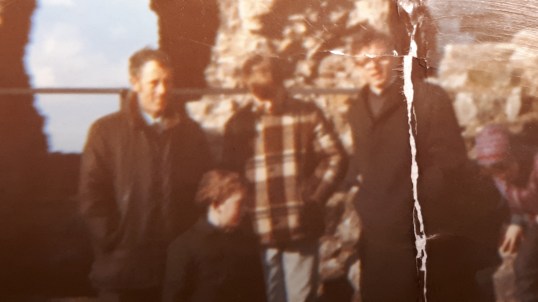
Attached to this posting is a photograph of the Comboni Missionary Romano Nardo with my family and myself. I came across it when my mother was sorting through her box of old pictures.

It was taken on a family day out to Llangollen Castle during Nardo’s stay with my family during the Easter of 1970. I am the child that is looking at the floor.

When I look back and think about Nardo’s visit that Easter, I recall – not that I gave it much thought at the time – that it created a difficult and uncomfortable atmosphere for my parents, especially my dad.

I had gone to Mirfield the previous September, as a lively, gregarious, playful, outdoor and mischievous child and returned home, with Nardo, during the Easter holidays of 1970, a subdued, unresponsive and – in my parents eyes – a completely different and unrecognizable son.

During the holiday I had little interest in my parents or my siblings. All I wanted was to spend time with Nardo; to the extent that I was awoken by him in the morning so that we could pray the morning breviary prayers together. The same took place in the evening for the evening prayers and vespers – we had to say them together. I found out later – through a statement that my eldest sister had given to lawyers – that my dad had found Nardo’s behaviour towards me both alarming and sinister.

On the occasion when I was sick and in bed, Nardo had asked if he could go upstairs and (for want of a better word) “comfort” me. It must have seemed a strange request. However, Nardo was a priest, what harm could it do. What harm indeed.

That very evening my mother’s chest must have swelled with pride as Nardo said mass – as he did everyday that he was with us – in our front lounge. My mum had a Comboni priest saying mass for her husband and her sons and daughters, here, right in her own house. A Comboni priest. A priest of the same order that she hoped and prayed her son would one day belong to.

Nardo did not only groom me for his own sexual gratification, he groomed and abused all my family through gaining their trust and using their hospitality as a means of sexually abusing me.

I am one of many seminarians at Mirfield that had their trust abused. My family is one of many families that had their trust in the Comboni Missionaries abused.

Mark Murray

20170927_221423

COMBONI MISSIONARIES AND THE BETRAYAL OF TRUST

TO THE COMBONI MISSIONARIES:

My wife, Julie, and i took our eldest son to University on Saturday.

It was a big day for us.

However, I gave it little thought during the days and weeks leading up to it.
Today, the house is a little empty, and in some ways it feels as if i have experienced a bereavement.

My son has gone. He has left the security and love, that was, literally, on his very own doorstep, to continue his journey in the world, with all the happiness and sorrows and challenges that that may bring.

The day ended up being a difficult day. Julie and I were not prepared for the emotions and thoughts and the overwhelming feeling of love and pride that rushed through us as we said good bye to our son

Soon after that good bye I began to think about my goodbye to my parents and their good bye to me when I was taken to Mirfield, at the age of thirteen, to begin my own journey towards becoming a priest.

My parents, I suspect, must have had the same thoughts and feelings of love and pride for me leaving home as Julie and I did for my son on Saturday leaving his home and going to university.

I was thirteen. How could my mum and dad do it?

How could they “let go” and leave me when I was so young?

The answer, of course, is based around trust. My parents believed that God had called me. They
believed in the sanctity of the Holy Vocation to the Priesthood. “God chose you, you did not choose
Him”

My parents trusted the Catholic Church. They trusted the priests of the Catholic Church. My parents, more than any other priests, trusted the Comboni Priests at their Junior Seminary at Mirfield.

I am angry about that. I am angry that i still feel angry. And I am angry for my mum and dad.

If my parents were alive they would be more than angry about what happened to their son at the hands of their trusted Comboni priests of Mirfield.

After the last Mirfield reunion (which I did not attend) I telephoned, the Comboni Missionary, Father John Clarke. Because, Father Clarke had spent some time at the reunion talking with Comboni abuse survivors, i was interested to discuss the abuse at Mirfield with him. Father Clarke was, and may still be, the Comboni Safeguarding Coordinator. His response to my question was, in words similar to or the same as, can you put all this in the past now, and move on.

Why am I writing all this?

I am writing this because it is linked to my thoughts and feelings about my eldest son leaving home, and it is linked to the trust that is entwined within that.

Many children went to Mirfield on trust. Their families trusted the Comboni priests at Mirfield to protect their children and to keep them from all harm.

That trust was betrayed in the most awful and despicable way. And to this day the abuse at Mirfield has not been addressed. And to this day there is no guarantee that it will ever be addressed or that the abuse by Comboni priests will not happen again.

And so, no, I and many others cannot “put it all in the past and move on.”

Mark Murray

Worst of Catholic Sexual Abuse Scandal Still to Come in Developing World

Worst of Catholic Sexual Abuse Scandal Still to Come in Developing World
A Report by Andrew West for the Religion and Ethics Report for ABC –
The Australian Broadcasting News

The worst of the Catholic sexual abuse scandal may be over in Australia, but the crisis is likely to hit the church in Asia, Africa and parts of Europe within a decade, a report has warned. Children and teenagers in church-run orphanages are at serious risk of abuse, the report says.

The study, “Child Sexual Abuse in the Catholic Church”, has for the first time compiled the findings of 26 Royal Commissions, police investigations, judicial probes, government inquiries, church studies, and academic research from around the world since 1985.

The Report warns the gravest potential for future abuse of children and teenagers lies in the estimated 9,600 orphanages the church still runs, including 2,600 in India and 1,600 in Italy.

“Child sexual abuse has peaked and there has been a decline since the late 70s and early 80s and that’s because it’s been brought into the public arena,” the study’s co-author, Professor Des Cahill, a former Catholic priest academic, said. “But I think in the developing countries and in some of the European countries, there hasn’t been a precipitating event to raise the issue into the public arena and I’m thinking particularly of countries in Asia and Africa. The issue may reassert itself after the current crisis has all blown over, and may come back in 30 or 40 years’ time if the underlying issues are not addressed”. He continued,
“As yet I have not seen any sign at the Vatican level, and even here in Australia, of the bishops answering why this happened and why they, the bishops, reacted so poorly.”

Examining reports from Australia, Ireland, the United States, Great Britain, Canada and the Netherlands, Professor Cahill and his co-author, theologian Peter Wilkinson, found that one in 15 priests, or about 7 per cent, allegedly abused children and teenagers between about 1950 and 2000. They say that even today children “are at risk in education and welfare institutions when they can be accessed by psychosexually immature and/or sexually deprived celibates, including priests and religious brothers”.

However, Professor Cahill, who was an adviser to the Australian Royal Commission into Institutional Child Sexual Abuse, believes the risks to children in Australian Catholic schools are now very low, mainly because of greater vigilance by parents, teachers and school authorities. He said that most Catholic school principals now are married men and women, and are extremely conscious of the risks to children. The decision of the Catholic Church in Australia, the US, Britain, New Zealand and Canada to phase out a large numbers of orphanages and move children into foster care has also substantially reduced the risk of abuse.

However, controversially the report of the Australian Royal Commission warns that Australia’s reliance on overseas trained clergy — up to 40 per cent in some dioceses — could be risky, as overseas bishops may try to banish offending or suspect priests to foreign postings.

“Is the phenomenon of child sexual abuse by priests and religious brothers likely to reappear and increase in the short or long term?” the report asks. “The answer is unclear. It might happen, despite even the most stringent checks that an offending priest or religious might be recycled to Australia. In the US, not a few overseas priests, especially from the Philippines and India, have been charged and convicted.”

The shortage of local candidates for the priesthood in many Western countries has, in the past, also led bishops to ordain men despite warnings from the heads of seminaries and training colleges that they were unsuitable. These included “psychosexually immature, psychosexually maldeveloped and sexually deprived and deeply frustrated male priests and religious, particularly those who had not satisfactorily resolved their own sexual identity”.

However, Professor Cahill and Dr Wilkinson do not blame the abuse crisis entirely on celibacy, but their report notes that there are low levels of abuse in the eastern rite Catholic churches — particularly the Maronite, Ukrainian, Melkite and Chaldean churches — where priests are allowed to marry and become fathers.

He rejects the claim, often made by church conservatives, that the liberal reforms of the Second Vatican Council in the early 1960s loosened the morals of priests. “Much of the abuse happened before Vatican II, during the 1950s and into the 1960s,” he said, “And the majority of offending priests were either ordained before Vatican II or well progressed in their studies. I think we need to be suspicious of those explanations.

—————————————————————————————————————-

(The Report above was Paraphrased for the Blog “The Comboni Missionary Order – A Childhood in their Hands” by Brian Mark Hennessy who has made further comments below).

The above report by Professor Cahill and Dr Wilkinson emphasizes a number of points that the Combini Survivors of child sexual abuse have been making to the United Kingdom Independent Inquiry into Child Sexual Abuse. Notably, that within the Catholic Church, children today are most at risk of being sexually abused and mistreated at the hands of clerics in the Religious Institutes and Orders of the Church that cater for the educational, health, welfare, youth and missionary programmes that they operate in developing countries.

Regrettably, it is known that in the past clerics who have abused children are known to have been posted to overseas locations by their Religious Superiors to remove them from the oversight of civil welfare and judicial organizations in the developed world where the issues surrounding child sexual abuse are better understood, and monitored – and where clerical abusers are more likely to face the prospect of being identified and prosecuted.